
 [
[



传统光合作用利用率不足1%,其核心瓶颈在于高能太阳光子激发的“热电子”会在数十飞秒(10-15秒)内通过与分子振动耦合快速弛豫为热能,导致能量大幅耗散。美国落基山国家实验室(NLR)构建了一种硅纳米晶半导体-钴肟分子催化剂杂化体系,通过乙烯基吡啶连接臂在界面诱导形成杂化电子态,将热电子寿命延长至至少5纳秒(10-9秒),较常规硅材料提升约25000倍,突破太阳能光催化效率瓶颈。
研究团队运用超快光谱学表征与量子力学计算揭示,乙烯基吡啶连接基团并非简单的物理“桥梁”,而是通过强化学耦合使电子态在硅纳米晶与钴肟催化剂之间离域杂化。这种“电子态融合”使高能电子同时分布于半导体和催化剂上,有效抑制了非辐射声子耗散途径。该发现颠覆了“仅需空间邻近即可实现高效光诱导电荷转移”的传统认知,证明界面连接基团的分子化学性质是决定光生载流子动力学行为的核心变量。
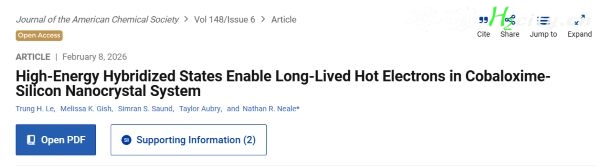
Strong electronic coupling is achieved between the molecular catalyst cobaloxime ([Co]) and silicon nanocrystals (Si NCs) bridged by an ethylenepyridine group derived from vinylpyridine (vpy) covalently bound to the Si NC surface (Si-vpy-[Co]). The ethylenepyridine tether in Si-vpy-[Co] is key to dramatic changes to the system’s physical properties─which are not observed in the corresponding formylpyridine (fpy) system (Si-fpy-[Co])─consistent with strong electronic coupling previously observed only in dark electrochemical systems. UV–vis absorption spectroscopy reveals new [Co]-centered electronic states in Si-vpy-[Co], and transient absorption spectroscopy finds a strong absorption feature appearing within 250 fs and persisting for at least 5 ns. Astoundingly, spectroelectrochemical measurements reveal that this absorption feature is consistent with both the singly reduced [Co]− and doubly reduced [Co]2– complexes, leading to the conclusion that these long-lived charges are derived from high-energy “hot” electrons residing in [Co]-centered states. Detailed analysis using cyclic voltammetry, spectroelectrochemistry, electron paramagnetic resonance spectroscopy, and density functional theory (DFT) calculations provides insight into the unique electronic structure created in Si-vpy-[Co]. DFT reveals that the new electronic states arise from hybridization between deep Si NC band states and high-energy molecular orbitals of the ethylenepyridine tether and the [Co] catalyst and are facilitated by σ-bonding character at the ethylenepyridine linkage. This study demonstrates that strong electronic coupling achieved through precise molecular chemistry can change the paradigm of otherwise fixed energy levels in hybrid photoelectrochemical systems for artificial photosynthesis and related applications.
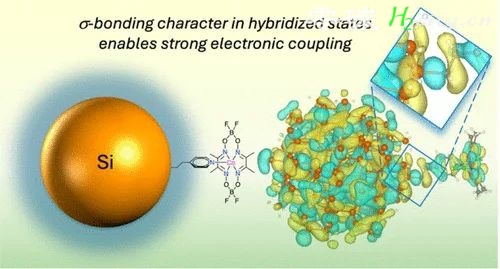 图1硅纳米晶体(Si)与分子催化剂钴氧肟(Co)之间化学反应
该技术路径可捕获植物和现有光伏板均无法利用的高能太阳光谱能量,直接驱动二氧化碳与水合成碳氢燃料、固氮制化肥等高能垒化学反应,推动人工光合作用从概念验证迈向实用化。延长热电子寿命意味着有望突破肖克利-奎伊瑟极限中的热化损失约束,为下一代光催化制氢、分布式太阳能燃料合成及零碳化工生产提供全新材料范式。相关成果发表于《Journal of the American Chemical Society》。
文献来源:
Le T H, Gish M K, Saund S S, et al. High-Energy Hybridized States Enable Long-Lived Hot Electrons in Cobaloxime-Silicon Nanocrystal System. Journal of the American Chemical Society, 2026. DOI: 10.1021/jacs.5c19326.
平台声明:该文观点仅代表作者本人,零碳未来网 系信息发布平台,我们仅提供信息存储空间服务。




The success of photovoltaics, wind, and other variable energy resources (1) has given commercial power providers many options for reliable, safe, and affordable electricity generation.