
 [
[



In this post, I review " Compressed Hydrogen Gas", "Liquid Hydrogen", "LOHC", and "Ammonia" as a means for hydrogen storage and transportation.
? a. Gaseous Hydrogen:
- Hydrogen gas pressure = '350-700 bar'!
- Gaseous hydrogen technology is easy to implement and inexpensive but has a relatively low volumetric energy density.
- Compressed gaseous hydrogen (GH2) @ 700 bar:
Molar mass (g/mol) = 2.016
Gravimetric energy density (MJ/kg) = 120-142
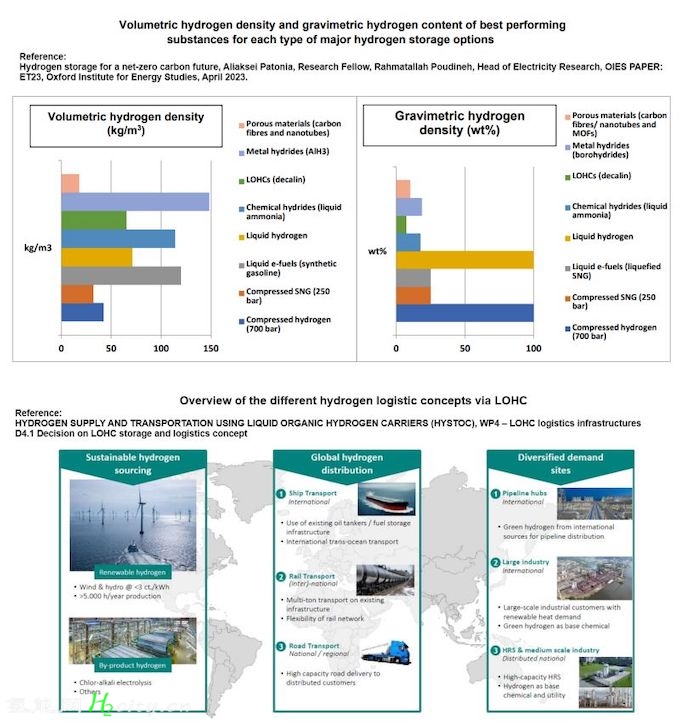
Volumetric H2 density (kg/m3) = 42
? b. Liquid Hydrogen:
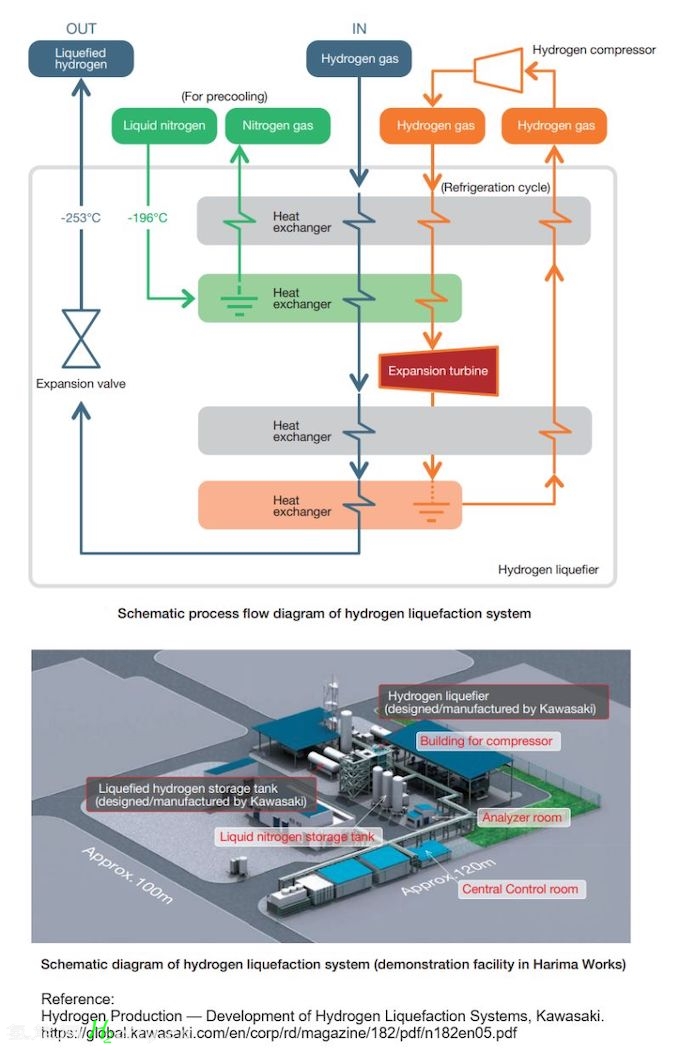
- Hydrogen can be liquified at low temperatures!
T = 20.28K (−252.87°C; −423.17°F).
- Hydrogen liquefaction is a mature technology. It is a carbon-free carrier.
- LH2 experiences boil-off during shipping and storage [ ~ 0.5% per day], and high equipment cost for Cryogenic temperatures is also a limitation.
- Molar mass (g/mol) = 2.016
Gravimetric energy density (MJ/kg) = 120-142
Volumetric H2 density (kg/m3 ) ≈ 70.8
? c. Liquid ammonia:
- Ammonia is produced by combining hydrogen and nitrogen through the Haber-Bosch process.
2NH3⇌N2+3H2
Temperature ≤ 650°C
Pressure ≤ 400 bar
- Ammonia is a carbon-free carrier with low transport loss, energy density, and hydrogen content.
- Using ammonia as a hydrogen carrier has a main limitation - its reconversion to hydrogen can consume around 30% of the energy contained in the hydrogen!
- Ammonia can be liquified more easily than hydrogen:
At –33°C and atmospheric pressure. Or at 20°C and 7.5 bar.
? d. Liquid Organic Hydrogen Carrier LOHC:
- Easily transportable, low cost, easily stored.
- High cost, low hydrogen content and high energy consumption for dehydrogenation are barriers of LOHC!
- Promising LOHCs:
Toluene/ methylcyclohexane (MCH) (C7H8/ C7H14);
Naphthalene/ decalin (C10H8/ C10H18);
N-ethylcarbazole C14H13N;
Benzene/ cyclohexane (C6H6/ C6H12); and
Dibenzyltoluene (DBT)/ perhydro-dibenzyltoluene (PDBT) (C21H20/ С21H33).
? e. Other Methods of Hydrogen Storage and Transport I will cover in separate posts:
1. Compressed gaseous hydrogen {GH2} @ [700 bar];
2. Compressed synthetic methane/ natural gas {SNG} [250 bar];
Captured CO2+4H2→CH4+2H20 [Sabatier reaction];
3. Hydrilyte® is a metal hydride dust suspended in mineral oil;
4. Gaseous Hydrogen Pipelines;
5. Compressed and liquefied synthetic natural gas (SNG);
CO2+4H2→CH4+2H20
6. Synthetic gasoline (petrol) (C8H18) and diesel (C12H23);
(2n+1)H2+nCO→[CnH(2n+2)]+nH2O
7. Methanol (MeOH);
CH3OH⇌CO+2H2
CO+H2O→CO2+H2
8. Formic acid (CH2O2);
9. Isopropanol (i-PrOH) (C3H8O);
10. Metal hydrides;
- Magnesium hydride (MgH2)
- AB5-type (LaNi5/ LaNi5H6)
-Alanates (NaAlH4)
11. Porous materials;
- Carbon fibres Cn(C3H3N)n
- Metal-organic frameworks (MOFs) Cr3F(H2O)2O(BDC)3.
✅ My posts reflect my personal perspective, knowledge, experience, and advice.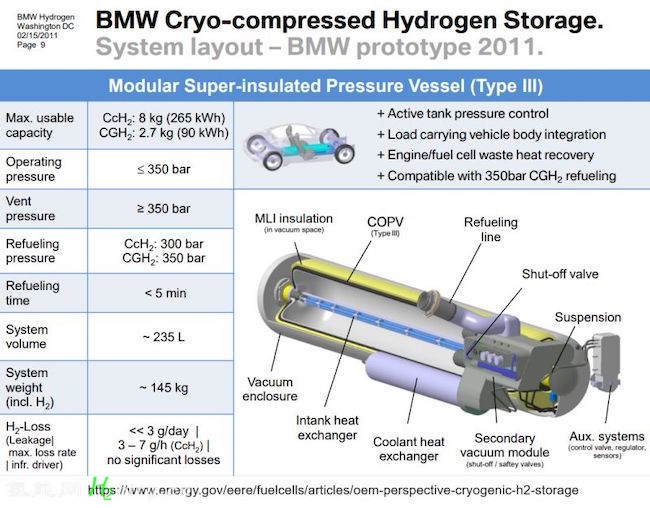
Which hydrogen storage method will become the most prevalent in the future?
平台声明:该文观点仅代表作者本人,零碳未来网 系信息发布平台,我们仅提供信息存储空间服务。


发表评论 取消回复